The polymer foam manufacturing industry is a complex combination of polymer chemistry and mechanical engineering. What reaches the consumer as an EVA foam sheet or an EPDM insulation sheet is the result of a precise process including mixing, curing, and stabilization of the cellular structure. At Foamiran factory, this process is carried out under strict quality control standards so that the final product meets the physical and mechanical properties required by the automotive, bag and shoe, and construction industries. In this specialized article, all technical stages of foam production, from the entry of raw materials to the final cutting, will be explained.
What is foam? Cellular structure analysis

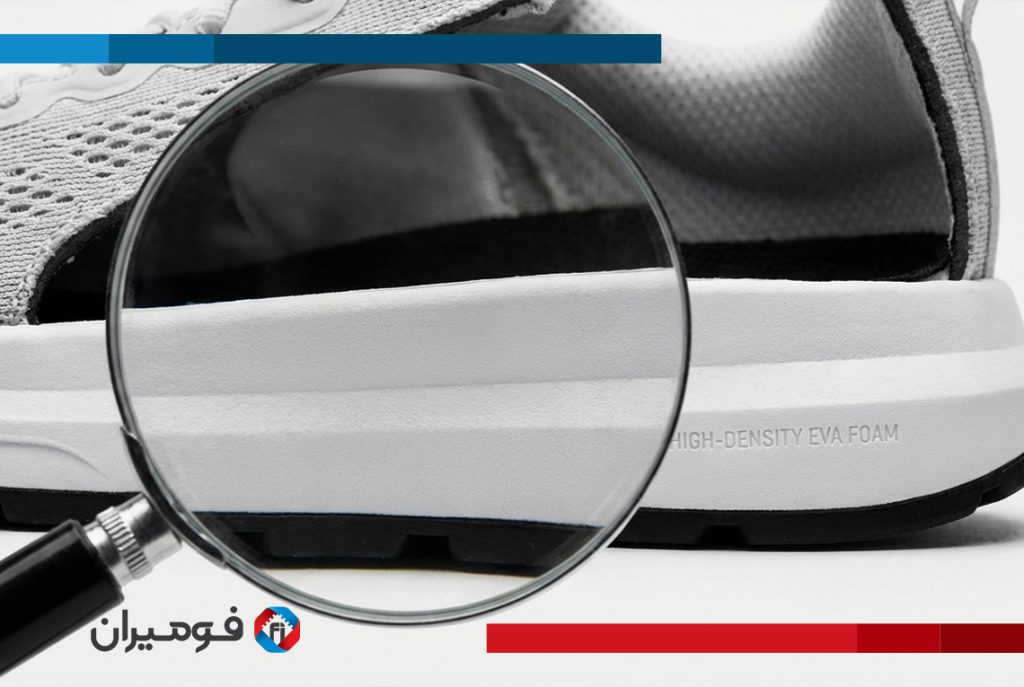
From a materials engineering perspective, foam is a colloidal structure in which a gas phase is trapped within a solid polymer matrix. This structure can be “Open Cell” or “Closed Cell”. Foamiran’s main products, such as EVA foam and Poly EVA, mainly have a closed-cell structure. This feature makes the foam resistant to water penetration and possess high elasticity and shock absorption properties. The foam production process is actually managing how these gas bubbles are formed and distributed within the polymer texture.
Raw materials for making foam
The quality of the final product depends directly on the formulation (Compounding). Polymer engineers in the Research and Development (R&D) unit determine the percentage of the following materials depending on the final application (e.g., softness for tatami or hardness for shoe soles):
- 1. Base Resin: The main polymer such as Ethylene Vinyl Acetate (EVA), Polyethylene (PE) or synthetic rubbers like EPDM and SBR which form the main body of the foam.
- 2. Blowing Agent: Chemical powders that decompose at a specific temperature and release nitrogen or carbon dioxide gas. This gas causes the polymer to puff and expand.
- 3. Curing Agent: Materials such as Dicumyl Peroxide (DCP) responsible for creating cross-links (Cross-linking) between polymer chains so that the foam retains its structure after expansion.
- 4. Fillers and Additives: Calcium Carbonate (to control price and hardness), industrial pigments, and Anti-UV materials for resistance against sunlight.
Complete foam production stages

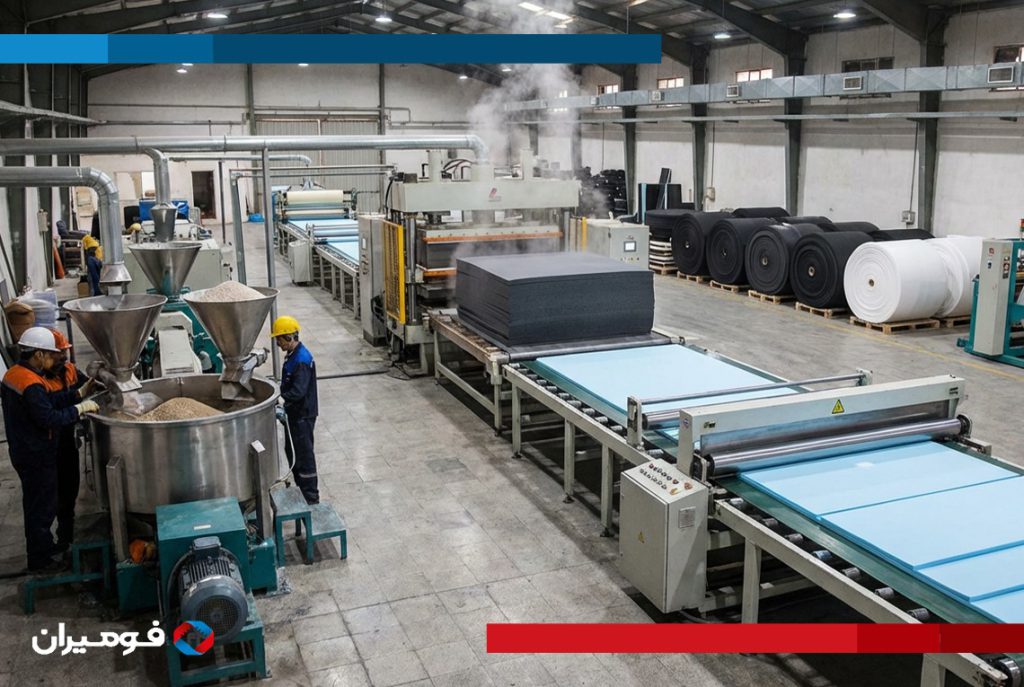
Foamiran’s production line is designed based on the “discontinuous production” or Batch system for sheet foams. This process is highly sensitive to temperature and time. The operational stages are as follows:
Stage 1: Precision Weighing
Everything begins in the weighing room. A deviation of even a few grams in the amount of blowing agent or curing agent can turn the entire production batch into waste. Digital weighing systems at Foamiran ensure that the formulation is adhered to with laboratory precision.
Stage 2: Mixing and Compounding
Raw materials enter the Internal Mixer or Banbury machine. In this stage, under pressure and friction, the polymers melt and additives are dispersed homogeneously within them. The output of this stage is a warm and uniform dough that has not yet turned into foam.
Stage 3: Calendering and Sheeting
The dough resulting from the mixer enters the Calender rollers to be converted into sheets of specific thickness and width. These sheets are still compressed and do not possess foam properties. These raw sheets are prepared for the main stage, which is curing.
Stage 4: Curing & Foaming
Raw sheets are placed inside hydraulic press molds. Under high pressure (about 150 to 200 bar) and heat (160 to 175 degrees Celsius), two events occur simultaneously:
1. The curing agent activates and strengthens the polymer network.
2. The blowing agent decomposes and releases gas.
As soon as the press opens, the sudden pressure difference causes the trapped gases to expand rapidly, and the small piece inside the mold transforms into a large, voluminous foam sheet (like opening a soda bottle).
Machinery required in the foam production line
Machine technology plays a decisive role in cell uniformity and foam surface quality. The industrial production line includes the following equipment:
1. Banbury and Kneader Machine:
Giant mixers responsible for the initial mixing of materials, breaking polymer chains, and creating a uniform dough.
2. Hydraulic Curing Presses (Vulcanizing Press):
The beating heart of the factory. Machines that perform the curing and foaming action with a combination of high heat (about 160 degrees) and heavy pressure.
3. Precision Cutting Machines (Splitting Machines):
After the foam block is produced, these machines cut the foam into sheets with millimeter thickness and very low tolerance using laser or band blades.
Types of industrial foam and technical specifications
The table below presents the specialized classification of manufactured foams based on chemical structure and engineering application. The choice of foam type must strictly align with project requirements.
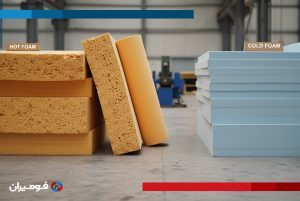
Methods of producing hot and cold foam and their differences
In the foam industry, there are two main methodologies that should not be confused with one another:
1. Hot Cure Foam:
This method is mainly used for producing cold polyurethane foams (such as car seat foam) as well as EVA foam sheets. In the EVA production process, which is Foamiran’s specialty, materials are baked at high temperatures inside an oven or hot press. Heat is the main factor activating the chemical reactions. The characteristic of this method is the production of foams with high density and very long lifespan.
2. Cold Cure Foam:
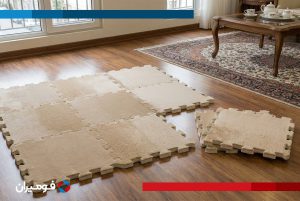
This term is mostly used in the furniture and car seat industry (Polyurethane). In this method, chemical materials puff without the need for high external heat and solely through the heat generated by the chemical reaction (Exothermic Reaction). Cold foam is usually softer and has faster resilience (rebound), but the process of producing hard industrial sheets (like tatami) is different from this method.
Strategic applications of foam in industries

The scope of foam applications goes beyond general imagination. Today, without the use of specialized foams, many industries would face challenges:
- Automotive Industry: Engine sound insulation, door sealing strips (EPDM), and dashboard shock absorbing parts.
- Medical and Orthopedic Industry: Production of moldable orthopedic insoles, medical collars, and rehabilitation equipment using biocompatible foams.
- Military and Safety Industries: Use of closed-cell foams for life vests (high buoyancy) and shock absorbers for sensitive electronic equipment.
Advantages and disadvantages of polymeric foams
To make a smart choice, one must recognize the strengths and limitations of this material:
Advantages (+)
- ✔ Extraordinary Lightness: Reduces transportation costs and structure weight.
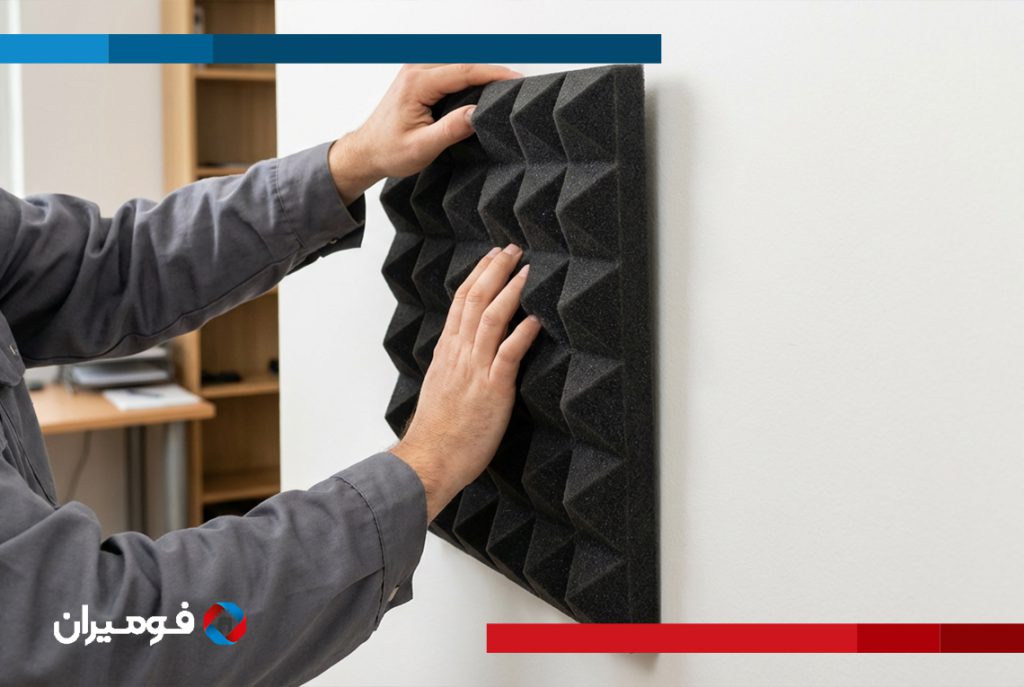
- ✔ Complete Insulation: Prevents energy loss and sound ingress.
- ✔ Versatility: Capable of being produced in any color, thickness, and hardness.
- ✔ High Durability: Especially in EPDM and Neoprene foams.
Challenges and Disadvantages (-)
- ✖ Sensitivity to Direct Heat: Most foams are vulnerable to direct fire (unless with fire-retardant additives).
- ✖ Environmental Non-degradability: Polymeric foams require a long time to decompose in nature (Solution: Industrial recycling).